All posts
Why PMs & Designers Need Worktrees, but Don't Need to Know It
Worktrees keep parallel software changes separate. LightSprint gives every ticket its own sandbox, so non-engineers get the safety without learning Git.
Ben Ong
September 20, 2026
worktrees
product-builders
cloud-sandboxes
agent-native
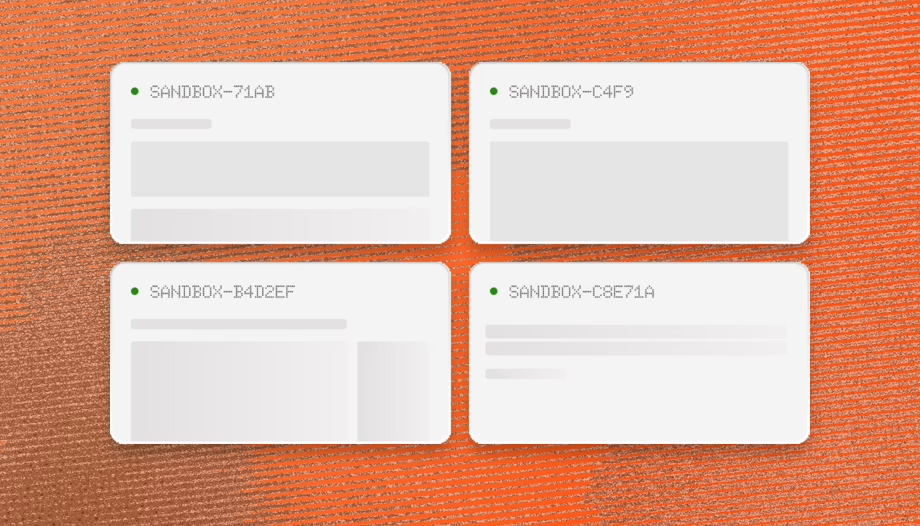
Four isolated sandbox environments floating over an orange halftone background
Non-engineers do not need to learn Git worktrees.
They need everything worktrees make possible.
A product manager should be able to ask an agent to change onboarding while a designer explores a new settings flow and an engineer fixes billing. Those changes should not overwrite each other, borrow each other’s half-finished files, or force everyone to wait for one shared environment.
Engineers already have a tool for this kind of separation. It is called a worktree.
The mistake is assuming everyone else needs to know that.
What a worktree actually gives you
Git describes a worktree as another working tree attached to the same repository. In practical terms, it lets you check out more than one branch at once. One change can live in one directory while another change lives somewhere else, both connected to the same codebase.
That sounds like a Git feature because it is. But the useful part is not the command. The useful part is the boundary.
Each piece of work gets its own place.
The onboarding change does not share half-edited files with the billing fix. An agent can install dependencies, change code, and run tests for one task without turning someone else’s task into collateral damage. When the work is done, that working area can be removed without disturbing the others.
For engineers running several agents at once, this is quickly becoming basic infrastructure. Without separate work areas, parallel agents are parallel only in theory. In practice, they collide in the same checkout, switch branches under each other, and leave behind a working directory nobody fully trusts.
The people closest to the product need the same protection
Product managers and designers are starting to build against real codebases, not just prototypes.
That changes the risk.
A prototype tool can give every idea a blank canvas. A real product already has users, data, tests, conventions, and several changes in flight. The question is no longer whether an agent can generate the interface. The question is whether it can make one change without disturbing the rest of the system.
Non-engineers need isolation for the same reason engineers do. Their intent may be expressed in plain English, but the agent still edits files, runs services, touches a database, and produces a pull request.
The infrastructure cannot become less serious because the interface became easier.
They should not have to operate the machinery
Telling every PM to learn branches, worktrees, dependency setup, ports, cleanup commands, and local environment recovery misses the point of coding agents.
The abstraction should move up.
A non-engineer should choose a ticket, describe the outcome, and work inside a safe place created for that task. The system should decide where the branch lives, how the environment starts, which services belong to it, and what gets cleaned up at the end.
They should see the things that help them make a product decision:
- The plan the agent intends to follow
- A live preview of the change
- Test results and verification evidence
- The discussion and decisions attached to the ticket
- The pull request engineering will review
They should not need a mental model of linked worktrees before they can move a button or test a new flow.
In LightSprint, every ticket gets its own sandbox
This is why LightSprint has the worktree model built into the workflow.
Every task on the board gets its own full-stack environment. The agent builds inside an isolated sandbox, with a branched database when the change needs one. The team can open a live preview, inspect the result, and iterate without touching production or another ticket’s work.
The ticket becomes the boundary.
A PM can work on onboarding. A designer can explore settings. An engineer can fix billing. Each task has its own code changes, running environment, and review history. The team can move in parallel without asking everyone to understand how that separation is implemented.
This goes beyond a raw Git worktree. A worktree separates checked-out files. LightSprint wraps that same principle in the environment the change needs to run, including the services, preview, verification, and pull request path around it.
The technical machinery is still there. It is simply doing its job instead of becoming the user’s job.
Isolation does not mean bypassing engineering
Making the build accessible does not remove the review gate.
Every LightSprint ticket still becomes a pull request. Existing branch rules, required reviews, GitHub Actions, and merge queues continue to apply. A non-engineer can propose, build, preview, and refine a change. An engineer still controls what reaches production.
That split matters.
Product teams get a much shorter path from intent to working software. Engineering keeps the controls that protect the codebase. The sandbox creates room to move quickly because mistakes stay contained until someone reviews the result.
The goal is not to make everyone an engineer. It is to let more people contribute without weakening the system engineers are responsible for.
Good infrastructure disappears
Most people who use Google Docs do not think about conflict-free replicated data types. They know several people can edit at once without destroying the document.
Worktrees should become the same kind of invisible infrastructure for agent-driven software work.
Non-engineers need separate work areas, parallel changes, disposable environments, and a clean path to review. They do not need the vocabulary lesson first.
They need to open a ticket and build safely.